
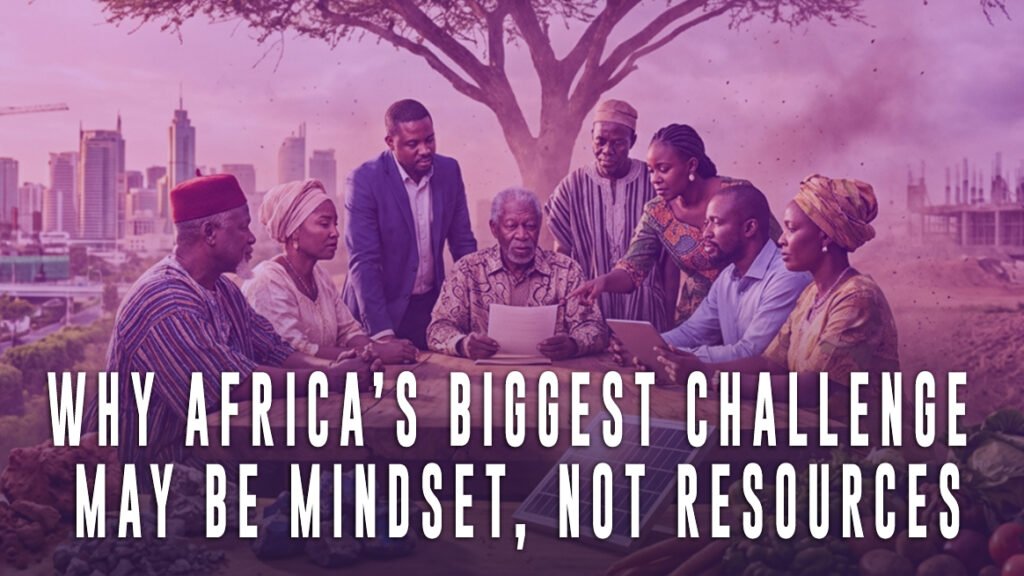
Discussions about Africa’s development often begin with a familiar observation. The continent is rich in natural resources. From minerals and energy reserves to vast agricultural potential, Africa possesses many of the assets commonly associated with economic growth. At the same time, there is widespread recognition that many countries across the continent continue to face persistent development challenges.
This contrast has shaped a common narrative.
If resources are abundant, then the primary challenge must lie in how those resources are accessed, managed, or distributed. As a result, conversations frequently focus on external constraints, structural limitations, and the need for increased investment or policy reform. These factors are important, and they play a meaningful role in shaping development outcomes.
Yet they do not always provide a complete explanation.
Across different regions, countries with similar resource endowments can experience very different trajectories. Some are able to build systems that gradually translate potential into progress, while others struggle to achieve consistent momentum despite having comparable advantages.
This raises a deeper question.
What if the difference is not only about what societies have, but also about how they think about what they have?
Framing the question in this way does not dismiss the importance of resources. Rather, it invites a broader perspective—one that considers how underlying patterns of thinking influence decision-making, leadership, and long-term development.
The Resource Argument
Natural resources have long been viewed as a central driver of economic development. Access to energy, minerals, and agricultural capacity can provide countries with the means to generate revenue, attract investment, and support infrastructure growth. In many cases, resource wealth creates opportunities for industrial expansion and improved living standards.
There is strong evidence to support this perspective. Countries with well-managed natural resources have been able to build robust economies, invest in public services, and create systems that support long-term stability. In this sense, resources can serve as an important foundation for development.
It would therefore be inaccurate to suggest that resources do not matter.
They shape possibilities and influence the range of options available to governments and institutions. They can provide the financial capacity needed to invest in education, healthcare, and infrastructure. In many contexts, resource availability can accelerate development when combined with effective systems and sound decision-making.
At the same time, the presence of resources does not guarantee a particular outcome.
There are examples across the world where countries with significant resource wealth have struggled to translate that potential into sustained progress. Similarly, there are nations with relatively limited natural resources that have developed resilient economies and adaptive institutional systems.

These contrasts suggest that resources, while important, do not operate independently.
Resources create opportunity, but they do not determine how that opportunity is used.
The effectiveness of resources depends on the systems through which they are managed and the decisions that guide their use. It depends on how institutions function, how leadership approaches long-term planning, and how societies respond to both opportunity and constraint.
Recognizing the importance of resources while also acknowledging their limitations creates space for a deeper exploration of development. It allows us to move beyond a single-factor explanation and consider the broader set of influences that shape outcomes over time.
Why Resources Alone Don’t Explain Outcomes
If resources were the primary determinant of development, we would expect countries with similar resource endowments to follow similar paths over time. In practice, this is rarely the case.
Across the world, nations with comparable access to natural wealth often experience very different outcomes. Some are able to build stable systems, diversify their economies, and adapt to changing global conditions. Others face recurring challenges that limit long-term progress, even when the underlying resource base remains strong.
This variation suggests that resources, while important, are not sufficient to explain the full picture.
Part of the difference lies in how resources are managed. Institutional capacity, governance structures, and long-term planning all influence whether resource wealth is used effectively. Yet even these factors do not operate independently. They are shaped by the decisions individuals make within institutions and the broader environments in which those decisions occur.
In other words, similar conditions can lead to different results depending on how societies engage with them.
The same resources can produce different outcomes when interpreted through different systems of thinking.
This becomes particularly evident when examining how opportunities are perceived. In some contexts, resources are approached with a focus on long-term value creation—investing in infrastructure, education, and economic diversification. In others, the emphasis may be more immediate, with fewer mechanisms in place to sustain long-term growth.
These patterns are not random. They reflect underlying approaches to risk, planning, and decision-making that develop over time within societies.
Recognizing this does not diminish the importance of resources. Instead, it highlights that resources function within broader systems. Their impact depends on how they are understood, how decisions are made around them, and how societies respond to both opportunity and constraint.
This realization opens the door to a deeper question—one that moves beyond what societies have and begins to explore how they think.
The Role of Mindset in Development
If resources create opportunity but do not determine outcomes, then the question becomes: what influences how those opportunities are understood and used?
One important factor is mindset.
In this context, mindset does not refer to individual attitude alone. It reflects broader patterns of thinking that influence how societies interpret challenges, approach decision-making, and respond to change. These patterns develop over time, shaped by education, cultural expectations, and institutional experience.
Mindset influences how opportunities are perceived. It shapes whether challenges are approached with a focus on adaptation or with reliance on familiar methods. It affects how individuals and organizations balance short-term priorities with long-term planning.
Mindset shapes how societies engage with the opportunities available to them.
For example, two environments with similar resources may approach economic development differently. One may emphasize diversification, innovation, and long-term investment. Another may rely more heavily on established systems, focusing on immediate returns without the same level of emphasis on sustainability.
These differences are not simply technical. They reflect deeper assumptions about risk, responsibility, and the nature of progress.
Mindset also influences how institutions function. The way rules are interpreted, how accountability is practiced, and how leadership decisions are made are all shaped by underlying patterns of thinking. In this sense, mindset operates within institutions as much as it does within individuals.

Importantly, mindset is not fixed. It evolves gradually as new ideas are introduced, as educational systems adapt, and as societies respond to changing conditions. However, because these patterns are deeply embedded, they can also persist even when external circumstances shift.
Recognizing the role of mindset does not imply that development challenges can be reduced to a single factor. Rather, it highlights that the effectiveness of resources, policies, and institutions is closely linked to how they are understood and applied.
This perspective invites a broader view of development—one that considers not only what societies possess, but how they engage with what they possess over time.
How Mindset Shapes Institutions and Leadership
Mindset does not operate in isolation. Over time, it becomes embedded within the institutions that societies build and the leadership patterns that guide them.
Institutions are often defined by their formal structures—laws, policies, and organizational frameworks. Yet how these structures function in practice depends on how individuals interpret and apply them. This is where mindset plays a significant role.
The same set of rules can produce different outcomes depending on the thinking patterns that guide decision-making within institutions. In environments where reflection, accountability, and adaptability are encouraged, institutions are more likely to evolve in response to new challenges. Where thinking is more constrained by rigid assumptions, institutions may continue to operate in familiar ways, even when circumstances require change.
Institutions function through the thinking patterns of the people within them.
This dynamic extends to leadership.
Leaders emerge from the same systems that shape broader societal thinking. Their approach to decision-making, risk, and long-term planning is influenced by the environments in which they have developed. As a result, leadership styles often reflect underlying patterns of mindset.
In some contexts, leadership may emphasize exploration, dialogue, and adaptation. In others, it may prioritize continuity and adherence to established frameworks. Both approaches can provide value, but they lead to different outcomes over time, particularly in environments that require flexibility and innovation.
Over time, leadership and institutions reinforce one another. Leaders shape institutional culture through their decisions, while institutions shape future leaders through the environments they create. This interaction allows patterns of thinking to persist, often across generations.
Understanding this relationship highlights that mindset is not only an individual characteristic. It is a systemic force that influences how institutions operate and how leadership evolves.
To fully understand its impact on development, it is necessary to consider how these patterns are carried forward over time.
The Generational Nature of Mindset
If mindset influences how individuals, institutions, and leaders respond to opportunity, then its impact extends beyond a single moment in time. It becomes part of a broader pattern—one that is carried across generations.
Each generation inherits more than resources or institutional structures. It also inherits ways of thinking. These include assumptions about how decisions should be made, how authority should be understood, and how challenges should be approached. Over time, these patterns shape how societies interpret both opportunity and constraint.
This generational continuity helps explain why certain approaches persist, even when circumstances change. Individuals entering institutions often adapt to existing ways of thinking, learning how systems operate not only through formal rules but through observation and experience. In this way, mindset becomes embedded within the structures of society.
What is considered “normal” thinking in one generation often becomes the foundation for decision-making in the next.
At the same time, this process also allows for change.
As new generations encounter different experiences, educational influences, and global perspectives, they bring new ways of thinking into existing systems. Over time, these perspectives can reshape institutions, influence leadership patterns, and alter how societies respond to emerging challenges.
This gradual evolution is central to the ideas I explore in Generational Shift. In the book, I examine how inherited patterns of thought can both sustain continuity and, at times, limit adaptation when new approaches are needed.

Understanding mindset through a generational lens invites a more patient and comprehensive view of development. It suggests that lasting change is not only about introducing new systems, but also about how new ways of thinking gradually take root within those systems over time.
Closing Reflection: Rethinking the Question
The question of whether Africa’s greatest challenge is resources or mindset is not one that lends itself to simple conclusions. Both matter. Resources shape possibilities, while mindset influences how those possibilities are understood and used.
Framing the discussion in this way is not about assigning blame or reducing complex challenges to a single cause. Rather, it is about broadening the conversation. It invites a deeper consideration of how systems of thinking influence the effectiveness of policies, institutions, and investments over time.
When mindset is aligned with long-term planning, adaptability, and thoughtful decision-making, resources can be used in ways that support sustained development. When underlying patterns of thinking remain constrained, even significant opportunities may not be fully realized.
Development is not only about what is available. It is also about how it is approached.
This perspective suggests that progress involves both structural and intellectual dimensions. It requires not only building systems, but also cultivating the capacity to engage with those systems in meaningful ways.
These ideas are explored further in my book Generational Shift, where I examine how patterns of thinking, carried across generations, shape leadership, institutions, and long-term development.
Understanding this interplay offers a more complete way of approaching the question—and a more grounded way of thinking about the future.